An upsetting text. A disappointing answer. A conversation that leaves your stomach in knots.
When uncomfortable feelings show up, it’s natural to want them gone—preferably immediately. Distress tolerance is your ability to get through those moments without letting the need for relief make your decisions for you. (Learn more about distress tolerance here.)
Can you make room for a difficult feeling while choosing what you do next?
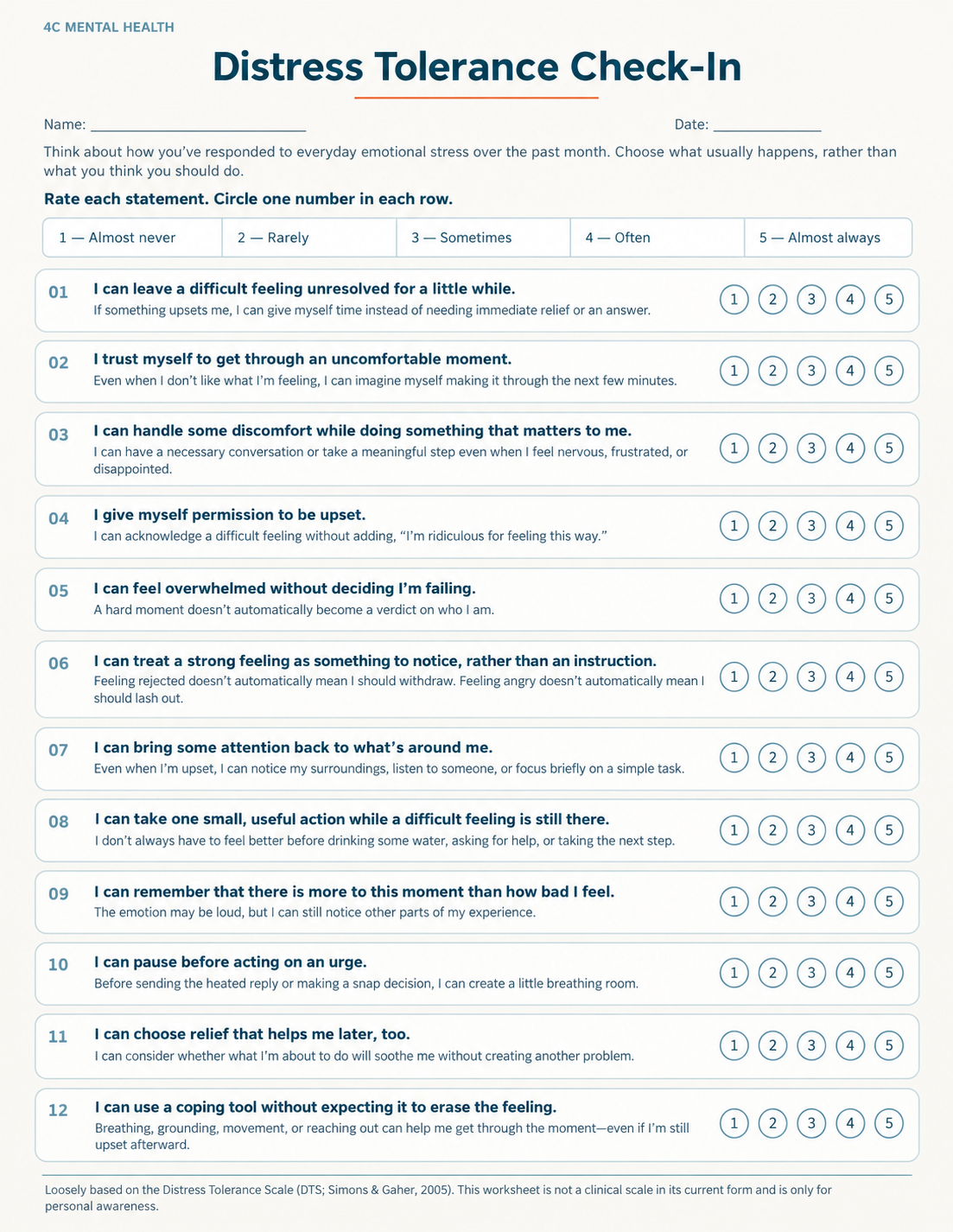
Take this quiz to find out how strong your distress tolerance skills are.
Your results
Add your answers for a total between 12 and 60.
These ranges are informal reflection guides created for this quiz. They are not clinical cutoffs or comparisons with other people.
12–27: Relief can feel urgent
When difficult emotions hit, getting away from them may become your top priority. That makes sense: discomfort can feel exhausting, especially when you already have a lot on your plate.
Your starting point is small: practice creating a brief pause between a feeling and an action. You don’t have to handle the whole day at once.
Try this: Before a nonurgent reaction, put your feet on the floor and take three slow breaths. Ask: “What would help me through the next minute?”
28–43: You have skills, but accessing them can be tricky
You can work through some uncomfortable moments, but certain situations may make your skills harder to reach. Perhaps uncertainty is manageable, while conflict or rejection hits much harder.
Look at when your skills disappear. That’s useful information about where you need more practice or support.
Try this: Pick one recurring trigger. Decide in advance: “When this happens, I’ll pause and use ___ before responding.”
44–60: You report a strong foundation
Your answers suggest you can often make room for uncomfortable feelings and choose your next move thoughtfully. You may be good at remembering that an emotion can be intense without needing to control everything you do.
Keep using support, breaks, and boundaries. Being able to tolerate discomfort doesn’t mean you have to carry everything alone.
Try this: Notice which skill helps you most. Naming it makes it easier to use deliberately during a tougher moment.
Find your next practice area
Your total gives you a broad picture. Your individual answers can be even more useful.
Look for the statements you rated 1 or 2:
Questions 1–3: Practice staying with manageable discomfort for a little longer.
Questions 4–6: Practice responding to your emotions with less judgment.
Questions 7–9: Practice gently bringing your attention back to the present.
Questions 10–12: Practice pausing and choosing a helpful response.
Choose just one to work on this week.
Remember: Distress tolerance means getting through difficult feelings while caring for yourself. It does not mean staying in an unsafe situation, accepting mistreatment, or ignoring a problem that needs action.
Join the conversation
Which is hardest for you: sitting with the feeling, being kind to yourself, getting unstuck from it, or pausing before reacting? What helps—even a little?


