Awareness Before Change: Slowing Down the Habit Loop
Many people think changing a habit starts with willpower.
Trying harder.
Being more disciplined.
“Just stop doing it.”
But most habits are not happening at a fully conscious level anymore.
They happen fast.
Automatically.
Almost reflexively.
Often the behavior begins before awareness fully catches up.
That’s because repeated habits eventually become wired into automatic brain pathways.
The brain learns:
“This behavior helps me regulate discomfort.”
And once the brain learns something creates relief, it starts running the pattern automatically.
Not because you are weak.
Not because you are broken.
But because the brain is trying to help you escape discomfort quickly.
The Habit Loop
Most habits follow a predictable pattern:
Trigger → Urge → Action → Relief
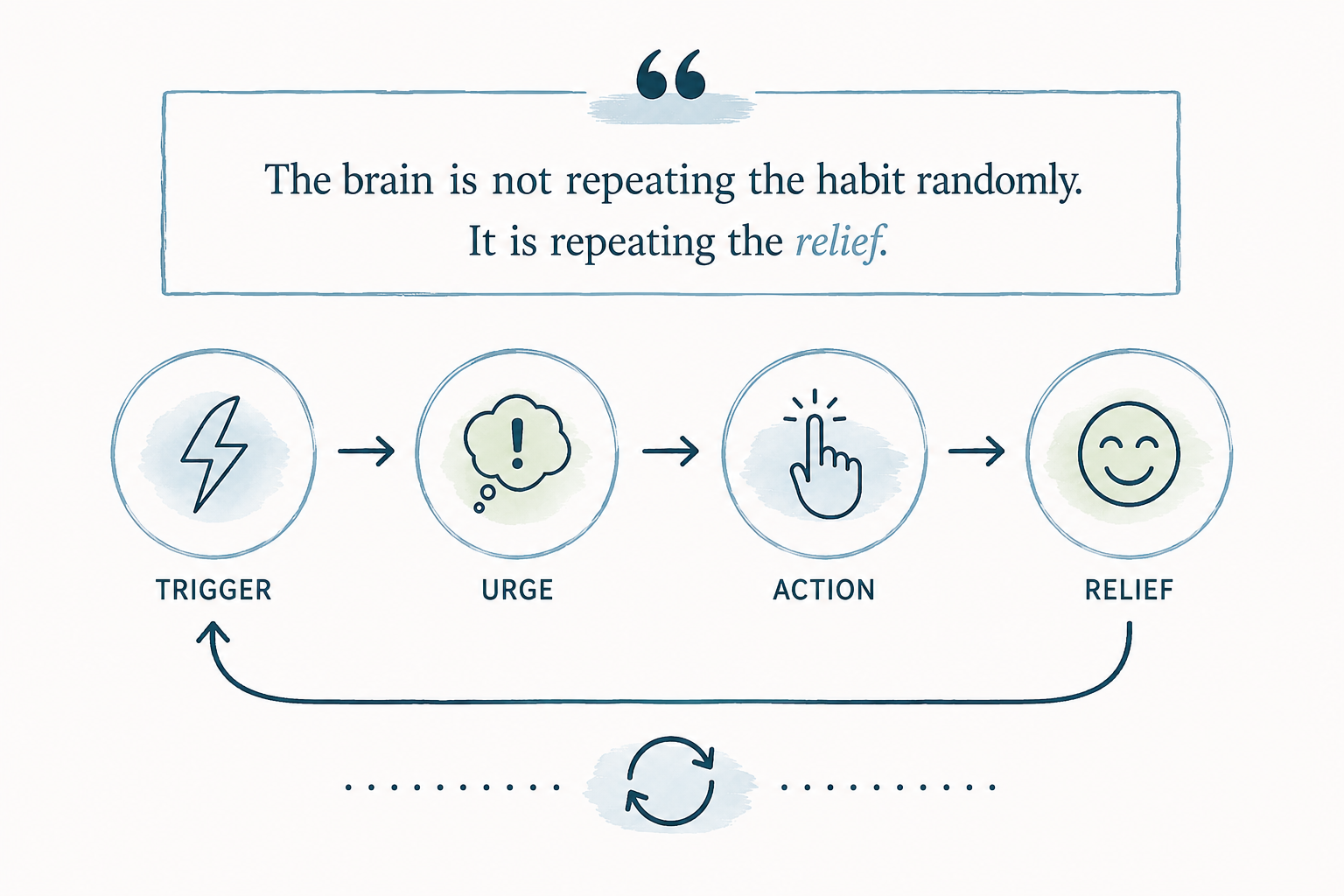
For example:
Stress → urge to escape → scrolling → temporary relief
Loneliness → urge for comfort → texting → connection
Anxiety → urge to avoid uncertainty → overthinking → temporary relief
Shame → urge to numb → overeating → comfort
The important thing to understand is this:
The brain is not repeating the habit randomly.
It is repeating the relief.
Even if the relief only lasts a few minutes.
That relief teaches the brain:
“Do this again next time.”
And over time, the loop becomes faster and more automatic.
Why Awareness Matters
One of the biggest mistakes people make is focusing only on the behavior itself.
The action is usually the easiest part to notice.
But the real change often happens earlier in the loop.
For many people:
the trigger goes unnoticed,
the urge barely registers,
and the action happens almost automatically.
That means the first step in changing a habit is not necessarily stopping it.
The first step is becoming more aware of the loop itself.
Because you cannot pause something you do not notice.
Exercise: Rating the Loop
Instead of trying to “fix” the habit, try observing it.
Choose one specific recent moment where you acted on a habit you are trying to change.
Then slow the moment down.
Walk yourself through each part of the loop:

The Trigger
What happened before the behavior?
Were you:
stressed?
tired?
lonely?
bored?
anxious?
overwhelmed?
angry?
ashamed?
How aware were you of the trigger in the moment?
The Urge
Was there a craving, pull, tension, or emotional discomfort before the action?
Did you feel yourself wanting relief?
Or did the behavior happen before you even fully noticed the urge?
How aware were you of the urge?
The Action
What did you actually do?
Scrolling?
Avoiding?
Texting?
Eating?
Checking?
Drinking?
Shutting down?
How aware were you while doing the behavior?
Most people notice this part most clearly.
The Relief
What emotional shift happened afterward?
Did you feel:
calmer?
distracted?
soothed?
numb?
more in control?
less anxious?
How aware were you of the relief afterward?
This part is often more subtle than people realize.
But understanding the relief helps explain why the brain keeps repeating the pattern.
The Goal Is Awareness, Not Perfection
This week is not about perfectly controlling yourself.
It is not about never struggling.
It is not about eliminating urges.
The goal is simply to notice the loop more clearly.
Because sometimes progress is not:
“I stopped the habit.”
Sometimes progress is:
“For the first time, I noticed the urge before I acted.”
That is real progress.
Awareness creates choice.
And choice creates change.


