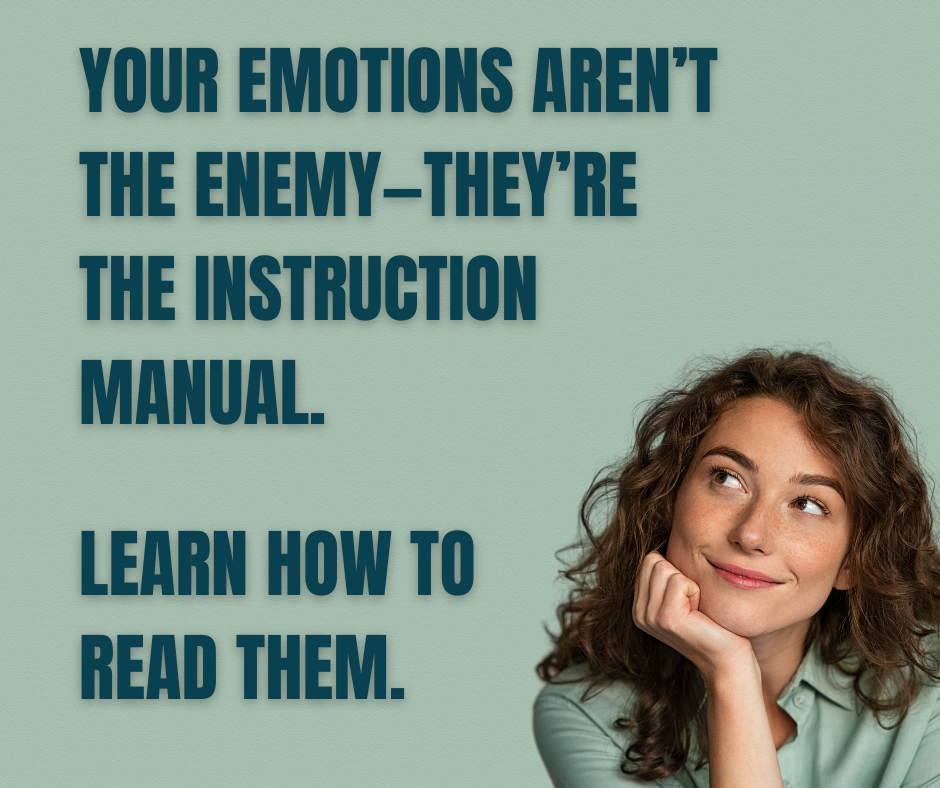
Ever wish emotions came with subtitles?
Wouldn't it be nice if anger whispered, “Hey, something feels unfair,” instead of just making your heart race and your fists clench?
Or if sadness quietly said, “You’ve lost something that mattered,” rather than weighing down your whole day?
The truth is: emotions are speaking to us all the time. But most of us never learned how to listen.
Let’s change that.
Emotions Aren’t the Enemy—They’re Messengers
We often treat emotions like a problem to solve. “I shouldn’t feel this way.” “I need to calm down.” “I don’t have time for this.”
But emotions actually exist for a reason. They’ve helped humans survive for thousands of years—not by accident, but by design.
Here’s the first surprising truth:
Emotions motivate and organize us for action.
That flash of fear before you cross a busy street? It’s your nervous system saying pause and scan.
That swell of anger after a boundary is crossed? It’s your body saying something’s not right—stand up for yourself.
In fact, many emotional “urges” are biologically hardwired. They prepare us to do something—fast. Think of it as an internal GPS rerouting you toward safety, connection, or justice. Emotions don’t just move us—they mobilize us.
But here’s where things get tricky.
Sometimes, we treat emotions as if they are facts.
“If I feel anxious, something must be wrong.”
“If I feel rejected, they must not care about me.”
“If I feel confident, it must mean I’m right.”
Sound familiar?
This kind of emotional reasoning can quietly run our lives—until we pause and ask, Is this emotion alerting me to something real… or is it a story I’ve told myself before?
That’s where real emotional wisdom begins: not in suppressing emotions, but in learning to fact-check them compassionately.
How to Actually Use This
So what does this mean for your daily life? Try these simple steps:
1. Ask: What is this emotion trying to get me to do?
Is it prompting action—or protection? Understanding the urge behind it can give you more choice.
2. Pause and reflect: Is my emotion pointing to facts—or fears?
Emotions are valid. But they’re not always truth. Get curious without judgment.
Final Thought: Emotions Aren’t Weakness. They’re Intelligence.
We don’t need to fear emotions. We need to befriend them.
They’re not here to sabotage us. They’re here to guide us—to act, connect, and reflect.
The more fluently you speak the language of your own emotions, the more empowered, grounded, and connected you become.
Because when you really think about it, emotions aren’t the opposite of logic.
They’re what tell us what matters.


