There’s a powerful concept found in both Buddhist psychology and modern evidence-based therapies like CBT and DBT that can completely change how you relate to emotional pain.
And once you see it—you can’t unsee it.
The Core Idea
Life will inevitably bring pain.
But what often keeps us stuck isn’t the pain itself—
it’s what we add on top of it.
You didn’t choose the pain—but you can learn not to keep adding to it.
(Or: did you have a bad day, or did you have a bad 5 minutes, and milk it all day?)
This is where your power lives. You get to choose your response.
Why This Matters (The Psychology Behind It)
Research across multiple areas of psychology points to the same pattern:
Observing thoughts without judgment reduces emotional reactivity
Labeling experiences (e.g., “this is anxiety”) can decrease amygdala activation
Self-criticism increases distress
Self-compassion increases resilience, motivation, and recovery
In other words:
It’s not just what happens to us—it’s how we respond internally that shapes our experience.
Metaphors for Ways We Accidentally Add Pain on Top of Pain
Metaphors are amazing because they give us imagery for everyday experiences. Our brains encode imagery differently, allowing us to recall them more easily. Here are some metaphors you've probably heard, which explain very common emotional experiences.
1. Drinking Poison and Expecting the Other Person to Die
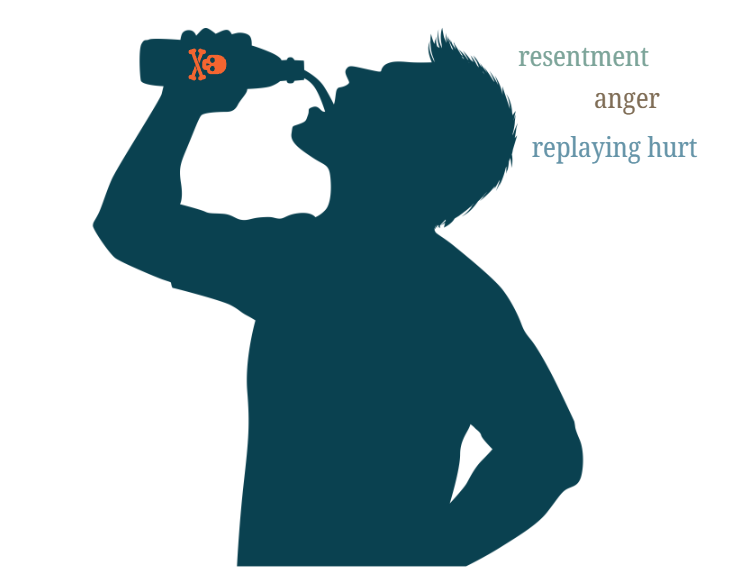
Concept: Holding onto anger, resentment, or rumination
Pain: “They hurt me.”
Stacked pain: Replaying it, staying angry, punishing yourself internally
We think we’re protecting ourselves—but we’re actually harming ourselves.
2. Carrying a Backpack That Keeps Getting Heavier

Concept: Accumulating judgments and stories
Pain: One difficult moment
Stacked pain: “This always happens,” “I can’t handle this,” “I’m falling behind”
Every thought you add is another weight you carry.
3. Pouring Gasoline on a Small Fire

Concept: Emotional escalation
Pain: A spark (stress, embarrassment, rejection)
Stacked pain: Catastrophizing, self-criticism
The original fire might have burned out—but we keep fueling it.
5. Picking at a Wound That’s Trying to Heal

Concept: Rumination and overanalysis
Pain: Emotional injury
Stacked pain: Reopening it through constant replay
Healing requires space—but we keep interrupting the process.
6. Living in an Echo Chamber

Concept: Thought amplification
Pain: One uncomfortable thought
Stacked pain: Repeating it, layering more thoughts on top
The louder the echo, the more real it feels.
Across all of these, the pattern is the same:
👉 Something happens
👉 We add meaning, judgment, or resistance
👉 And that’s where suffering multiplies
The Shift
You don’t need to eliminate pain.
You just need to start noticing:
What is the actual moment of pain?
What am I adding on top of it?
You don’t have to fix it.
Just seeing the difference…is the first step in stopping the stacking.
Which of these metaphors is most useful to you today?


