Most people don’t walk around thinking, “I’m really resilient” or “I’m good at coping.”
Usually, it’s the opposite:
You focus on what you didn’t handle well
What you wish you did differently
Or where you still feel stuck
But here’s something important:
You’ve already used real, effective coping skills to get through hard things.
You just may not recognize them as strengths.
There’s strong psychology behind this:
In Solution-Focused Therapy, we look at what’s already working—not just what’s wrong
-
When people identify their strengths:
They feel more capable
They follow through more
They build resilience faster
And at a brain level, this shifts your belief from:
“I’m not handling this well”
to
“I can handle things.”
That belief changes behavior.
You don’t need to become a different person.
You already have pieces of what you need.
This is about seeing them—and using them on purpose.
Step 1: Identify Your Strengths
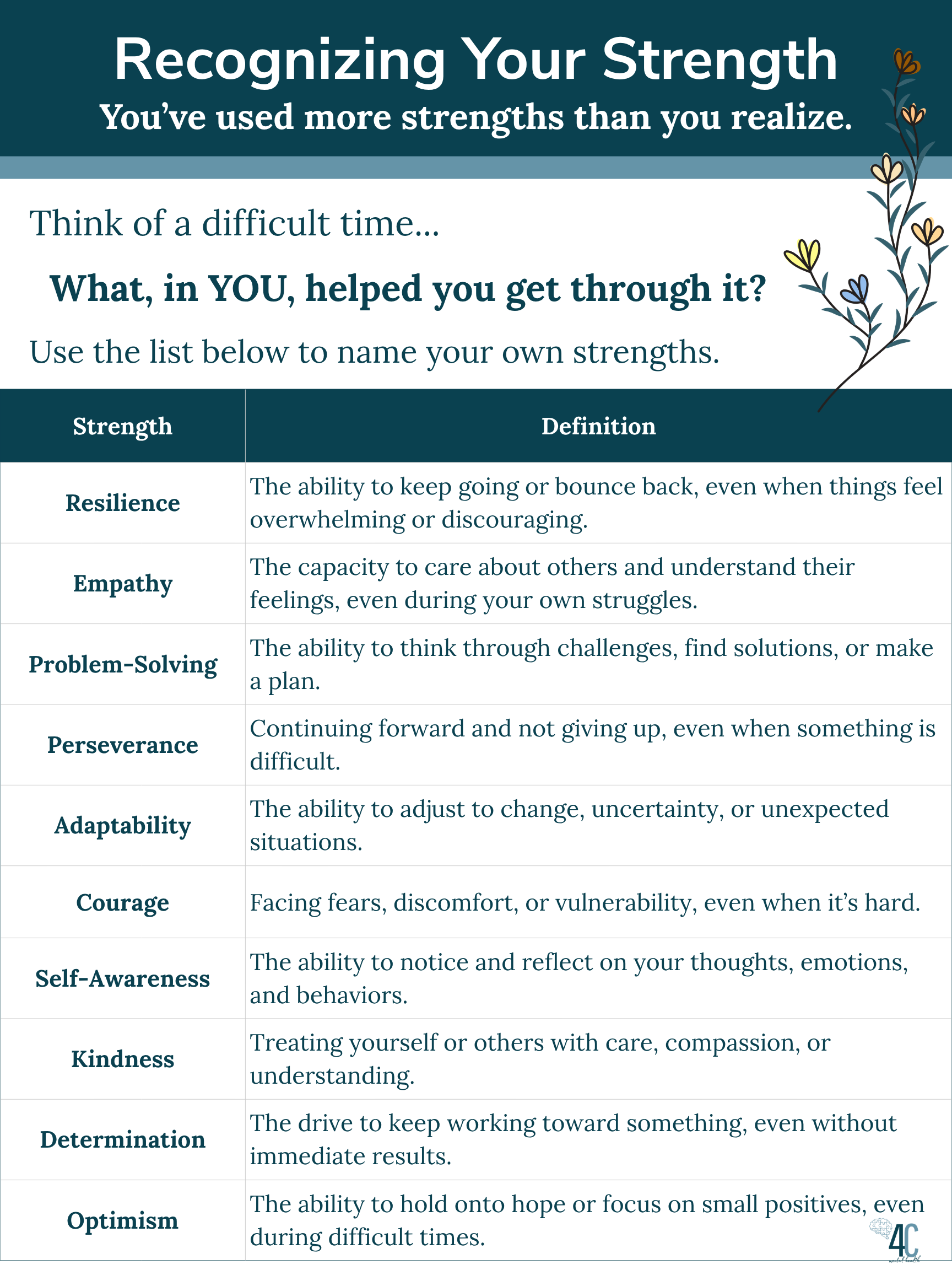
Look at the list.
Circle:
Your top 2-3 strengths (these feel natural to you)
1 strength you have, but don’t use enough (this is your growth edge)
Step 2: Make Your Strengths Real
For each of your top 3 strengths, reflect:
Where does this strength show up naturally in my life right now?
When is this strength easiest for me to access?
When do I not use this strength—even though I could?
Now shift from awareness → action:
What is one specific situation coming up where I can intentionally use it?
This is SO KEY. You have it, you just forget to use it sometimes. Don't forget your weapons at home when you go into battle!
Step 3: Learn From Each Other
Now we move beyond self-reflection. We don't all have the same strengths (which is beautiful). Something that comes naturally to you might be really hard for someone else. This is a powerful opportunity to grow together (and when you help someone else tap into strengths, you reinforce them for yourself and keep them top of mind for you).
Think about one strength for the list that you want to grow.
-
Ask others in the comments about how they use that strength:
“How do you use this in your life?”
“What does this actually look like for you day-to-day?”
The goal:
Steal strategies from each other.
Because strengths aren’t just traits—they’re skills you can learn to apply.
You already have strengths.
This isn’t about finding them.
It’s about using them on purpose.