If behavior change were just about wanting something badly enough, most of us would already be living radically different lives.
We’d exercise consistently.
We’d leave unhealthy relationships sooner.
We’d stop habits we know are hurting us.
We’d finally start the thing we keep thinking about.
But motivation isn’t that simple—because human beings are rarely unmotivated. We’re ambivalent.
Ambivalence: The Most Misunderstood Part of Change
Ambivalence means holding two competing truths at the same time:
“I want things to be different.”
“I don’t want to give up what this gives me.”
Every behavior—even the ones we dislike—serves a purpose.
Anxiety keeps you vigilant.
Avoidance keeps you safe from disappointment.
Numbing behaviors give you relief when things feel unbearable.
Why “Just Try Harder” Backfires
When we shame ourselves for not changing, we usually double down on the very behavior we’re trying to stop.
Why?
Because pressure increases threat—and threat shuts down the parts of the brain responsible for reflection, flexibility, and long-term planning.
Motivation grows in safety, not self-attack.
This is why lectures, ultimatums, and harsh inner dialogue rarely create sustainable change. They skip the most important step: understanding the function of the behavior.
Motivational Enhancement Therapy (MET) is a collaborative, evidence-based approach that helps people resolve ambivalence about change by strengthening intrinsic motivation and autonomy rather than using pressure or persuasion. Research shows MET is effective across substance use, health behavior change, and mental health contexts, often performing as well as longer treatments while producing more sustainable change. And, today…we get to practice it!
A 3-Step Framework for Reducing Shame and Restoring Choice
Motivation doesn’t come from pressure.
It comes from clarity, safety, and autonomy.
This framework isn’t about making yourself change.
It’s about helping your nervous system feel safe, and understood, enough to decide.
Step 1: Make Both Sides Explicit (Using the STAY & CHANGE Worksheets)
Now we give both sides of the ambivalence a voice — on purpose.
Use the worksheet below to slow this down.
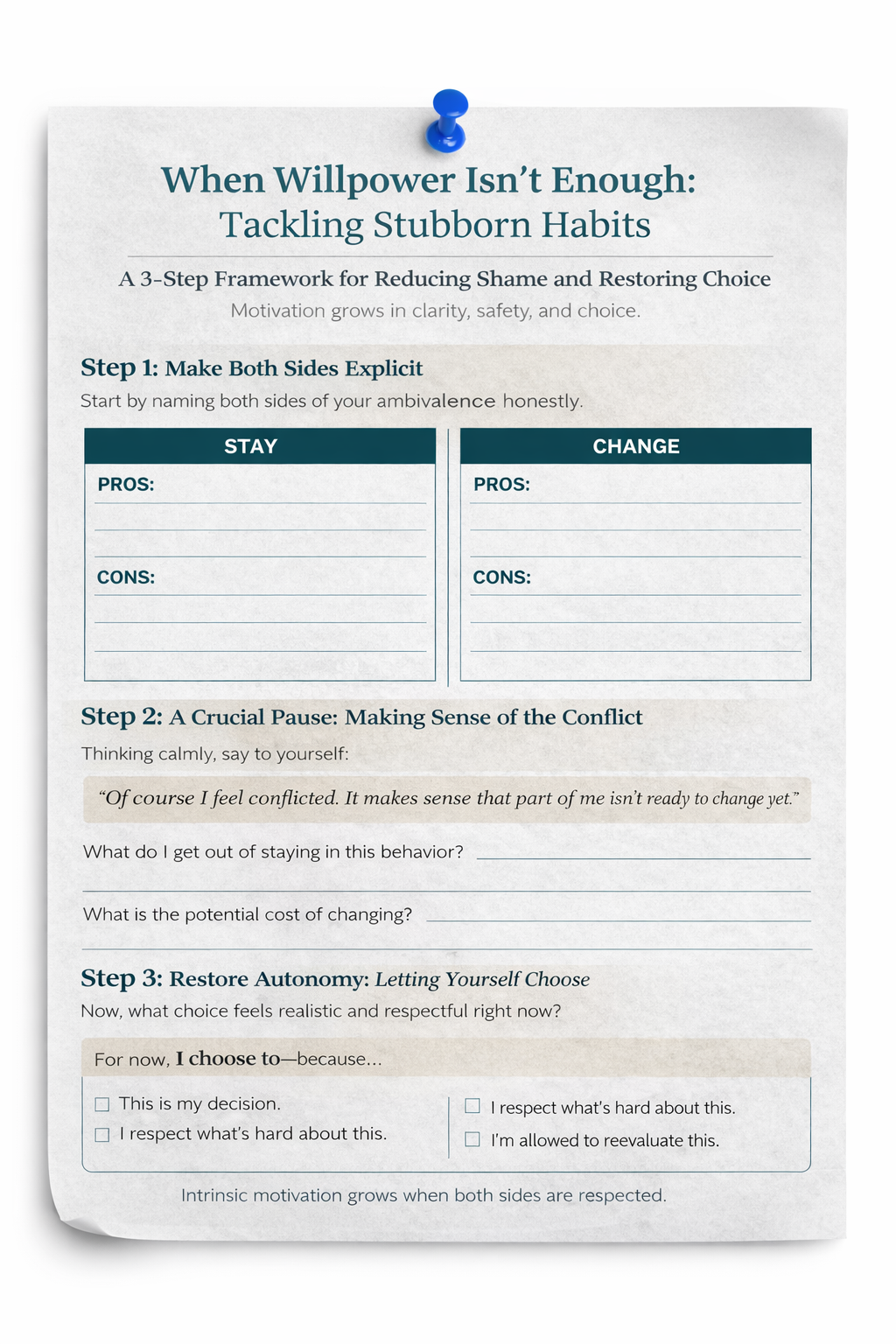
Here’s a sample, from someone trying to limit social media time:

Box 1: STAY (Pros & Cons of Staying the Same)
This is where people are usually secretly operating from.
Ask honestly:
What do I gain by staying the same?
What does this protect me from?
What feels safer or easier about not changing?
What are the real costs of staying here?
Step 2: A Crucial Pause: Making Sense of the Conflict
As you look at your pros and cons for staying the same, take a moment to name what’s actually happening:
“Part of me wants things to be different.
And part of me doesn’t want to give this up.”
Let yourself say:
It makes sense that this behavior exists.
It’s doing something for me.
Of course change feels risky.
Most people skip this moment and jump straight to self-criticism:
“I should be past this.”
“Why can’t I just stop?”
“Other people handle this better than I do.”
But judgment activates threat, and threat shuts down reflection.
This is often the turning point.
When the conflict is understood — rather than attacked — shame loosens, and choice becomes possible.
Ready to move on?
Step 3: Box 2: CHANGE (Pros & Cons of Changing)
Now look at the other side — without forcing optimism.
Ask:
What might improve if I changed?
What would feel more aligned or meaningful?
What would changing cost me emotionally, socially, or practically?
What fears show up when I imagine change?
When both boxes are complete, something important happens:
You’re no longer asking, “What should I do?”
You’re asking, “Given these tradeoffs, what do I choose?”
That shift alone reduces shame.
Step 4: Restore Autonomy. The power to Choose
After reviewing both worksheets, explicitly remind yourself:
“I am allowed to choose.”
That might sound like:
“I’m not ready to change this yet — and that’s a conscious decision.”
“I want to change, but not in the way I thought.”
“I’m choosing to stay for now, and I understand why.”
This isn’t giving up.
It’s reclaiming agency.
When change feels forced, the nervous system resists.
When choice is restored, resistance softens.
Ironically, people often become more open to change after they stop pressuring themselves to change.


