Many people unknowingly place most of their self-worth into a single part of their identity.
A career.
A relationship.
A role like “the strong one,” “the helper,” or “the successful one.”
And when that one pillar shifts—through job loss, illness, burnout, divorce, or life transitions—it can feel like everything collapses.
This isn’t a personal failure.
It’s a very human pattern.
Psychologically speaking, when identity becomes too narrow, it becomes fragile. When identity is expansive, it becomes resilient.
The goal isn’t to care less about the important things in your life.
It’s to stop letting any single thing carry the entire weight of who you are.
That’s where identity mapping comes in.
Why a Broader Identity Builds Emotional Resilience
Research in psychology consistently shows that people with multiple, well-integrated identity domains cope better with stress, loss, and change. When one area is threatened, the nervous system doesn’t interpret it as a total collapse—because it isn’t.
Think of identity like a table:
One leg → unstable
Many legs → steady, even when one wobbles
An expansive identity:
Reduces shame after setbacks
Buffers against anxiety and depression
Increases adaptability during transitions
Creates a deeper, more compassionate self-relationship
This exercise helps you see that wholeness clearly.
The Identity Mapping Exercise
This is not about judgment.
It’s about awareness, flexibility, and self-compassion.
Step 1: Start at the Center
Grab a blank piece of paper.
In the center, write:
“Me”
That’s it. No labels. Just you.
Step 2: Map the Major Spheres of Your Identity
Around the center, draw circles representing the different roles, relationships, and domains that make up your life right now.
These might include:
Family roles
Friend groups (separate them if they serve different functions)
Work or career
Creative outlets
Spiritual or religious life
Cultural or ethnic identity
Hobbies or passions
Personal values
Physical health or body identity
Important:
Make the circles different sizes based on how central they feel to your life today.
There is no “correct” sizing.
Big circles often hold power.
Small circles still matter.
Here's an example:
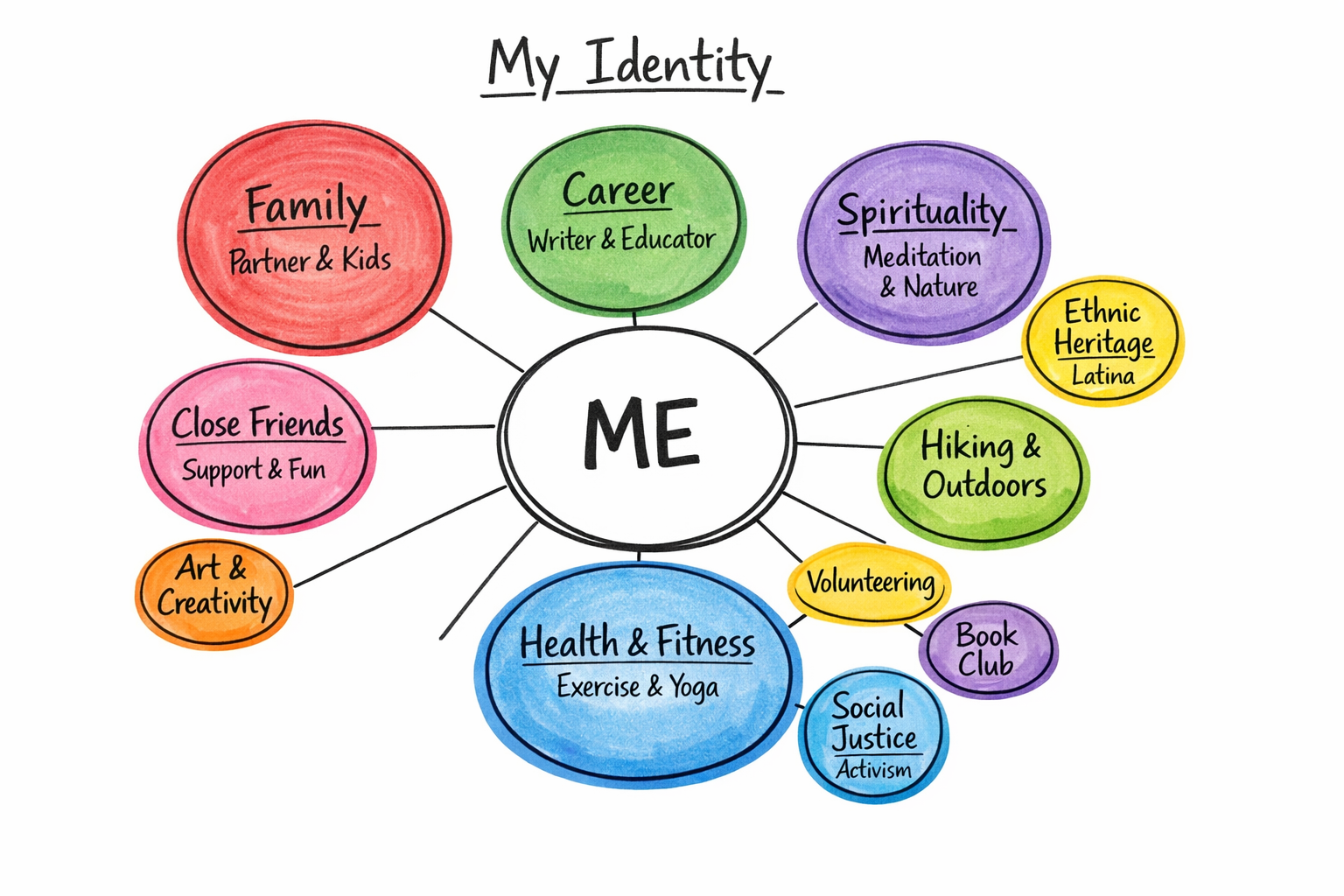
Step 3: Add Reflection
For each one, write a sentence answering this question:
“If this part of my life could describe me, what might it say?”
Examples:
“She is a deeply loyal friend.”
“He shows up consistently, even when it’s hard.”
“Her creativity moves people.”
And sometimes:
“She cancels a lot.”
“If only he believed in himself more.”
Let it be honest—not polished.
Nothing needs to be fixed yet.
Step 4: Pause and Reflect
Before moving on, ask yourself:
Does this feel accurate for who I am today?
Are there parts of me missing?
Are any circles carrying too much weight?
Sit with it. Awareness alone is powerful.
Now the Key Shift: Do It Again—Five Years From Now
Turn the page or grab a fresh sheet.
Repeat the entire process as you in five years.
Don’t overthink realism. Think possibility.
Ask:
Which circles grow?
Which shrink?
Which disappear?
Which new ones emerge?
How do the “quotes” change?
This step activates psychological flexibility—your brain’s ability to imagine change without fear.
Why This Exercise Is So Powerful
This isn’t just a reflection exercise. It works because it:
Externalizes identity (you can observe it instead of being trapped inside it)
Reduces fusion with any single role
Creates space for self-compassion
Reframes change as evolution, not loss
You begin to see that you are not your job, your productivity, your relationship status, or your worst season.
You are a living system—capable of growth, expansion, and reinvention.
If you feel comfortable, share:
What surprised you
What felt heavy
What felt hopeful
Often, simply witnessing your own complexity is enough to soften self-criticism and restore a sense of agency.
You are more than one thing—and that is your strength. And, with awareness, you get to shape your future self, focusing on resilience.


