We often picture confidence as boldness — the person who speaks the loudest, takes up the most space, or never seems uncertain.
But real confidence isn’t performance.
It’s peace.
It’s that quiet steadiness that comes when you stop arguing with your own worth.
From an early age, many of us learn that confidence looks like charisma — strong eye contact, firm tone, decisive action.
While those can signal confidence, they don’t create it.
Research from cognitive-behavioral psychology shows that authentic confidence is less about external behavior and more about cognitive stability — the ability to self-validate, manage self-critical thoughts, and regulate emotions when faced with uncertainty.
In other words: real confidence isn’t about being sure.
It’s about being steady when you’re not.
When you feel misunderstood, it’s natural to want to explain. To show your intentions, your effort, your heart.
But the urge to prove is often less about them — and more about you trying to settle something inside yourself.
It sounds like:
- “If they just understood, I’d finally feel okay.”
- “If I could explain it better, they’d see my worth.”
- “If they don’t believe me, does that mean I’m wrong?”
This is where we get stuck — in a feedback loop of external validation. The brain, wired for social belonging, mistakes acceptance for safety. But safety built on other people’s approval will always feel unstable.
You can’t anchor your self-worth in shifting tides.
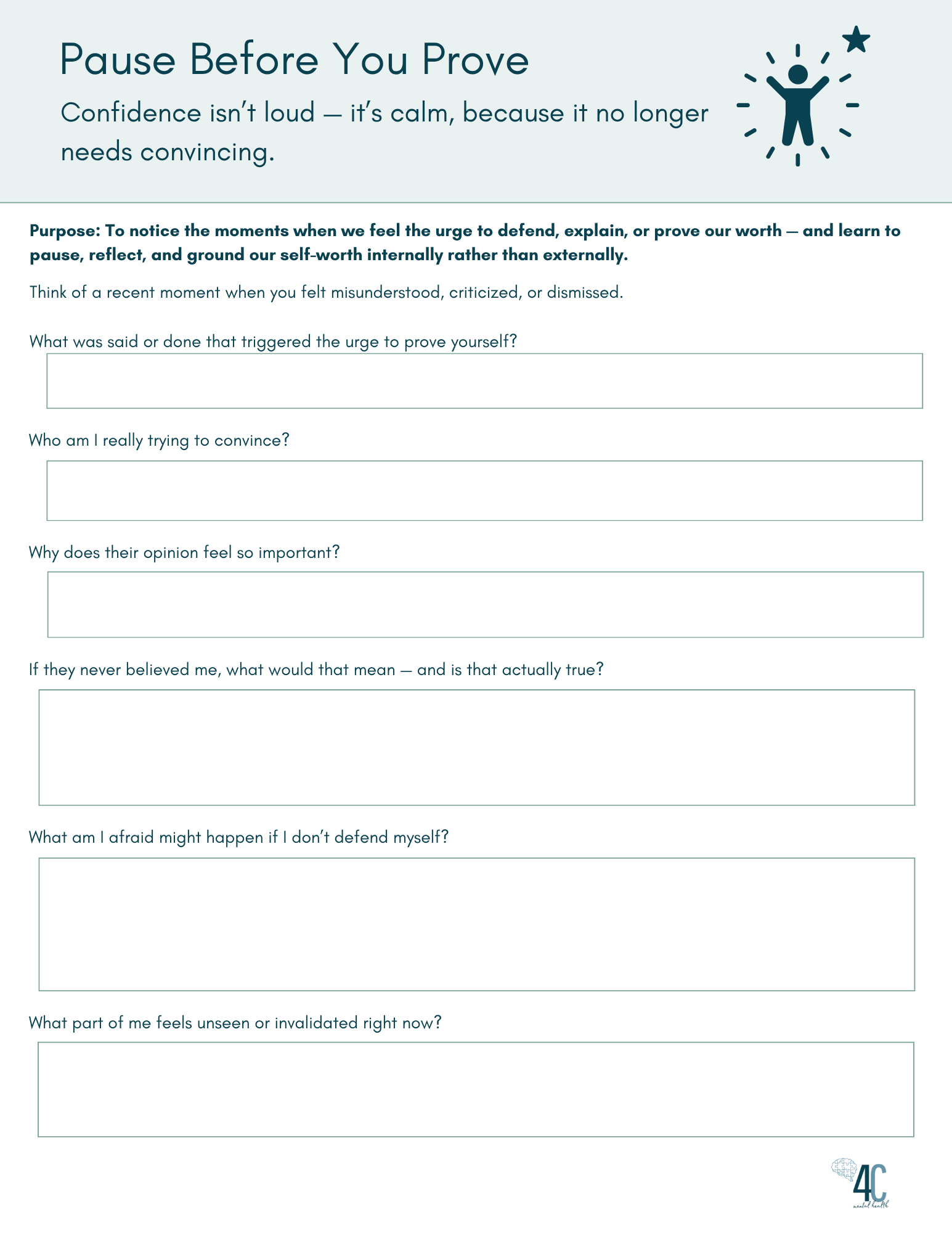
💡 The Intervention: Pause Before You Prove
The next time you feel the urge to explain, defend, or justify yourself — pause.
Take one slow, deep breath.
Then ask yourself a few quiet questions:
“Who am I really trying to convince right now?”
“Why does this feel so urgent?”
“If they don’t believe me, what do I think that means about me?”
“Am I sure that’s true?”
Often, you’ll find that the person you’re trying hardest to convince — is yourself.
That pause is where power begins.
It’s the moment where emotional reactivity softens, and self-trust steps in.
It’s where your nervous system learns that not every disagreement is danger.
You reclaim calm by refusing to prove.
In today's coping skills class, we walked through this worksheet, and had a powerful conversation about conflict, rejection, judgement, control, and how so many of these reactions come from within ourselves, NOT from the situation or the person.
Want more on this? Be sure to check out our conflict course for guidance on negotiation and managing complex interactions.