Maybe it's:
"I'm not good enough."
Or...
"People will leave."
Or...
"If I make a mistake, everyone will notice."
Even though the situations are different, the story feels strangely familiar.
That's because our minds don't start from scratch every day.
They build on what we've learned throughout our lives.
Some of those lessons help us.
Others...can quietly shape the way we see ourselves without us even realizing it.
Why This Happens
Our brains are always looking for patterns.
As we move through life, they ask questions like:
What should I expect?
Who can I trust?
What kind of person am I?
To answer those questions, our minds look at our experiences and begin forming beliefs about ourselves, other people, and the world.
Sometimes those beliefs are helpful:
"I can figure things out."
"Most problems have solutions."
"It's okay to make mistakes."
Other times, our minds draw conclusions that are less helpful:
"I'm not good enough."
"People will reject me."
"If I make a mistake, I'll be judged."
These beliefs don't usually appear overnight.
Psychologists call these core beliefs.
You can think of them as the "operating assumptions" your mind uses to understand the world.
They're built gradually from the experiences we have, the messages we receive, the relationships we form, and the way our brains make sense of those experiences, and can emerge from any number of sources, or a combination of sources, including:
caregivers/parents
temperament (some people are naturally more sensitive or cautious)
siblings
peers
bullying
teachers and coaches
romantic relationships
trauma
culture and social media
repeated successes or failures
even one highly emotional event, in some cases
And perhaps most importantly: two people can have the same experience and develop different core beliefs. That's because our brains aren't recording events like a camera—they're interpreting them.
Most of the time, we aren't even aware they're there.
But they quietly shape how we interpret new situations.
For example, if someone has come to believe, "I have to be perfect to be accepted," they may interpret small mistakes very differently than someone whose mind has learned, "Everyone makes mistakes, and that's part of learning."
Neither person is choosing to think that way.
Their minds are simply using old patterns to make sense of a new situation.
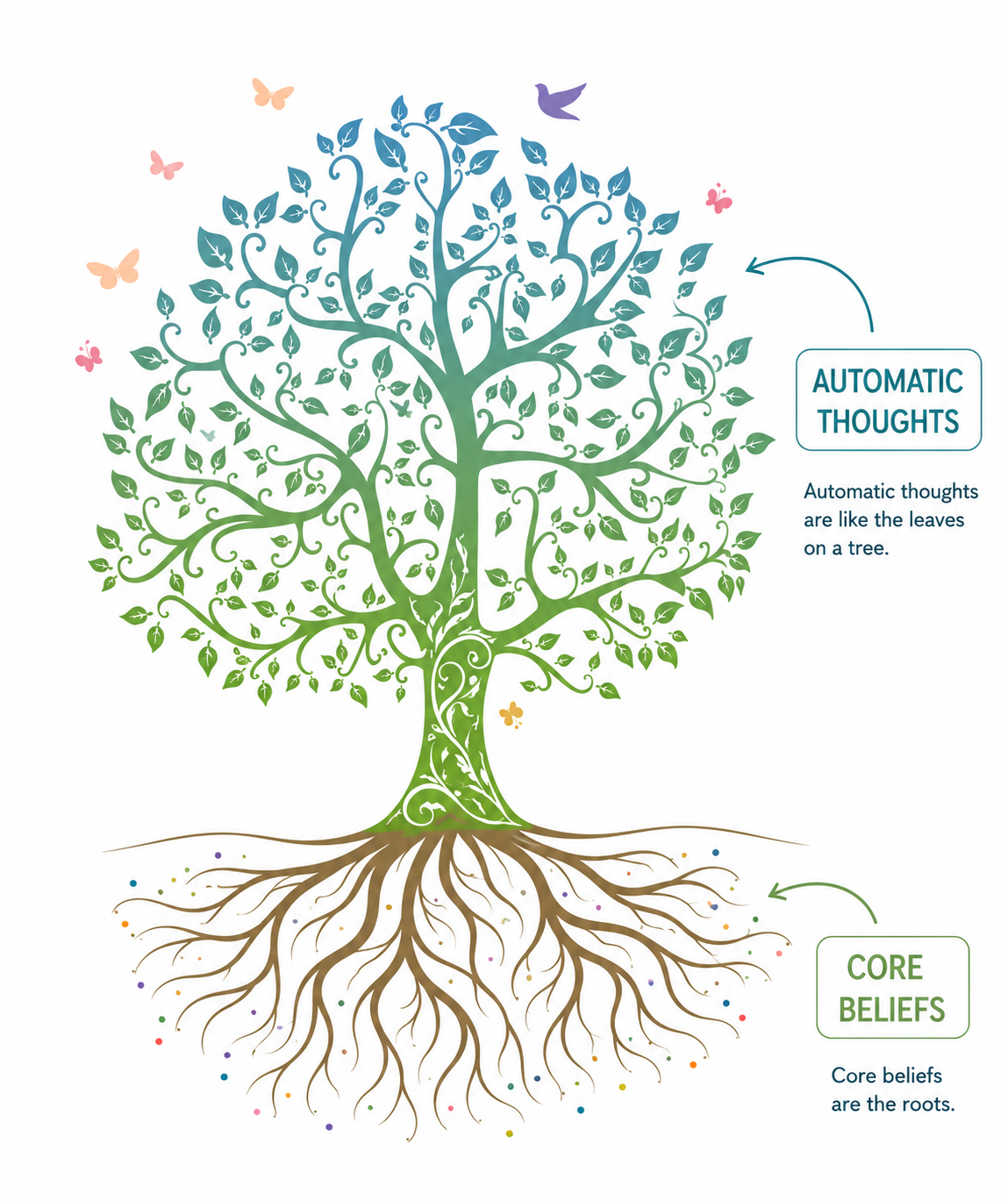
Automatic thoughts are like the leaves on a tree.
Core beliefs are the roots.
If we only focus on the leaves, similar thoughts will keep growing back.
When we discover the roots, we begin to understand why certain situations affect us so strongly.
The goal isn't to judge ourselves for these beliefs.
It's to become aware of them.
Because once we can see the story our mind has been telling, we can begin asking whether it's still serving us.
Going Deeper
By now, you've learned that automatic thoughts don't appear out of nowhere. They're often connected to deeper beliefs we've developed over time—stories about ourselves, other people, and the world.
Most of us aren't aware of these stories. We simply experience them as "the way things are."
But once we begin to uncover them, something powerful happens.
We realize that a thought like "I'm going to fail" may actually be rooted in a deeper belief like "I'm not good enough." Or a fear of rejection may stem from a deeper story that says, "People always leave."
Understanding these deeper beliefs isn't about blaming ourselves—or anyone else. It's about becoming curious.
Because once we can name the story, we no longer have to let it quietly shape our lives.
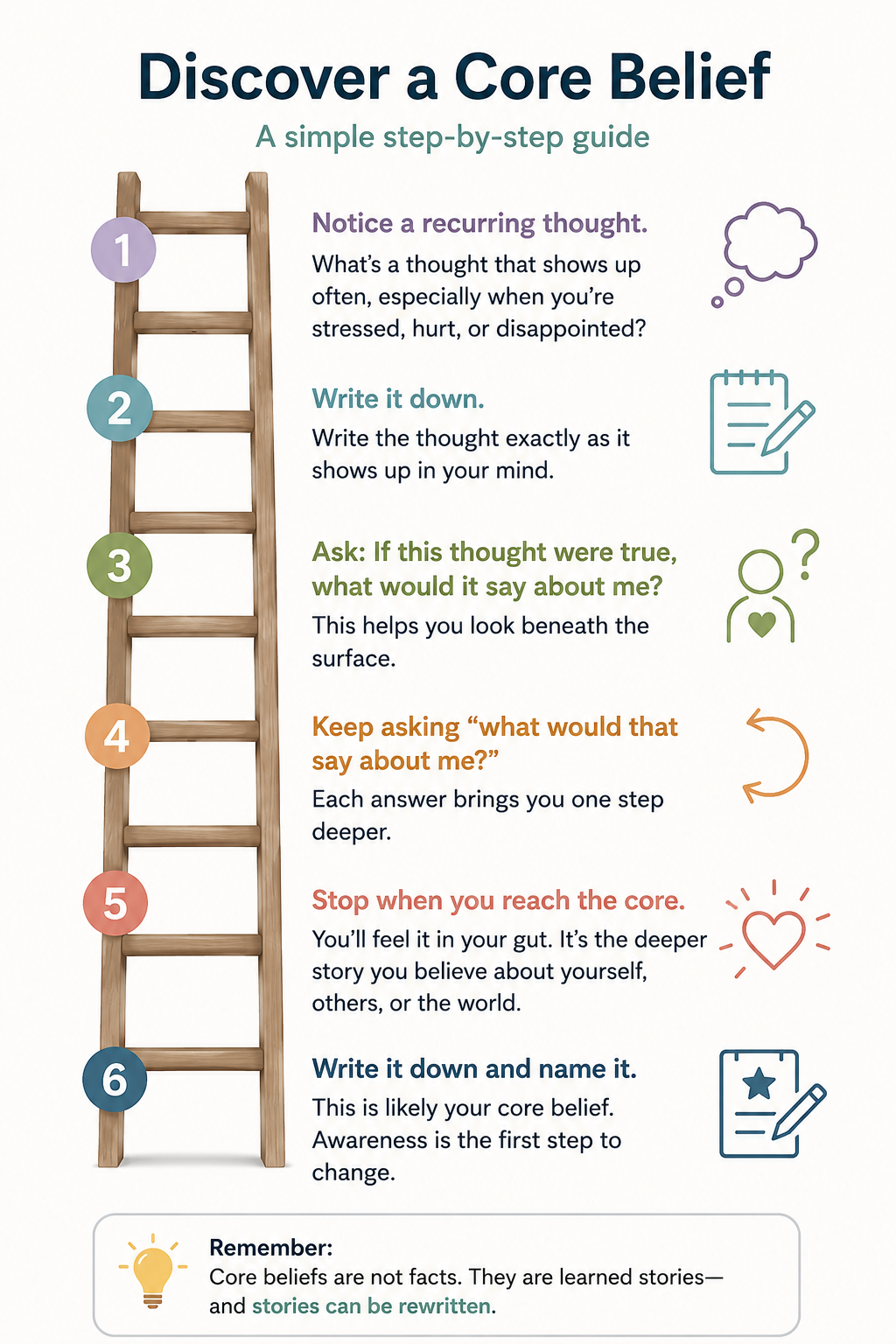
The exercise below will help you gently explore one of your own recurring thought patterns and discover the deeper belief that may be underneath it.
You may not uncover a core belief on your first try—and that's okay. The goal isn't to find the "right" answer. It's simply to become more aware of the stories your mind has learned over time.
Awareness is where change begins.