Let's try a simple exercise to demonstrate this concept.
Emotion Charades: What Are We Really Seeing?
At first glance, this exercise seems simple:
Look at a face. Guess the emotion
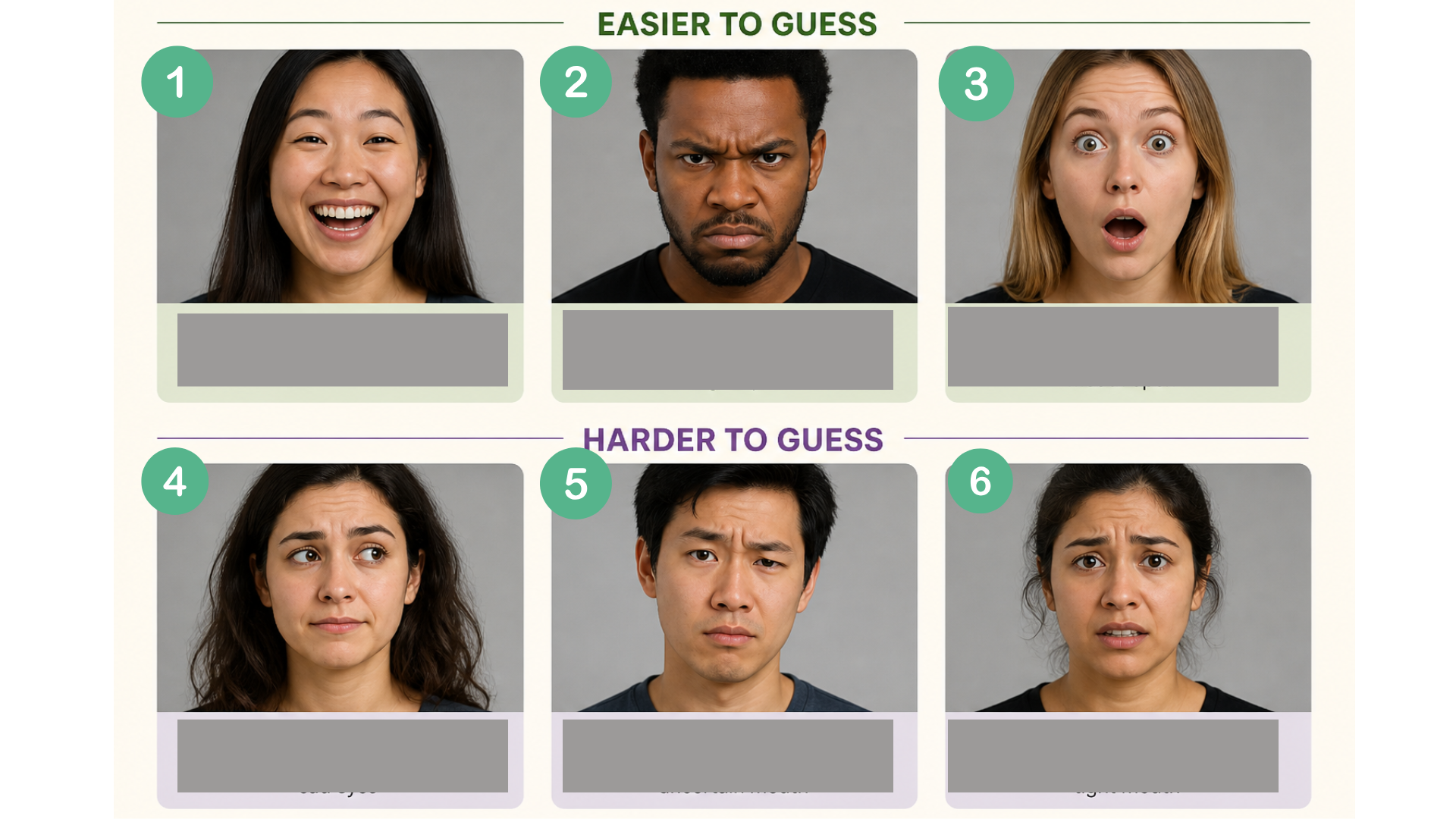
.
But once you try it—even with “easy” emotions—you quickly realize something:
It’s not as obvious as we think.

Now Reflect.
1. Was it easy or hard to guess? Why?
Were some emotions obvious?
Were others confusing or unclear?
2. What made certain emotions easier to recognize?
Big expressions (like happiness or anger)?
Familiar patterns?
3. What made it harder?
Subtle emotions (like disappointment, shame, uncertainty)?
When expressions looked similar?
What This Teaches Us
1. We’re not as accurate as we think
We often assume we know how someone feels just by looking—but this exercise shows how easy it is to misread.
2. Many emotions look similar
Anxiety, excitement, and fear can overlap.
Frustration and sadness can blend.
What we see isn’t always the full story.
3. Context matters more than we realize
In real life, we rely on tone, body language, history, and situation—not just facial expression.
When you remove those, things get much harder.
4. People express emotions differently
Not everyone shows feelings the same way. Culture, personality, and past experiences all shape expression.
5. This is why we need to ask—not assume
Instead of:
“I know you’re mad.”
Try:
“You seem upset—am I reading that right?”
When We Think We’re Communicating Clearly… But Aren’t
Here’s the part people don’t expect:
It’s not just that we misread others.
It’s that others may be misreading us, too.
You might feel like you’re clearly showing:
hurt
overwhelm
frustration
…but the other person sees:
anger
distance
disinterest
Or nothing at all.
Why?
Because:
You may express emotion more subtly than you realize
The other person is interpreting through their lens, mood, and past experiences
Facial expressions alone don’t carry enough information
This is where communication breaks down.
Not because people don’t care—
but because they’re filling in the gaps with guesses.
What Helps
Instead of assuming your emotions are obvious, try naming them:
“I’m not mad—I’m overwhelmed.”
“I think I’m coming across as quiet, but I’m actually feeling hurt.”
“This is hard for me to say, but I’m feeling anxious right now.”
And when reading others, stay curious:
“You seem a little off—what’s going on?”
“I might be misreading this, but are you feeling stressed?”
Key Takeaway
We are constantly “reading” each other—but we’re often guessing more than we think.
This exercise builds:
Awareness
Humility
Curiosity
…and those are the foundations of better communication and stronger relationships.